 Banff City Guide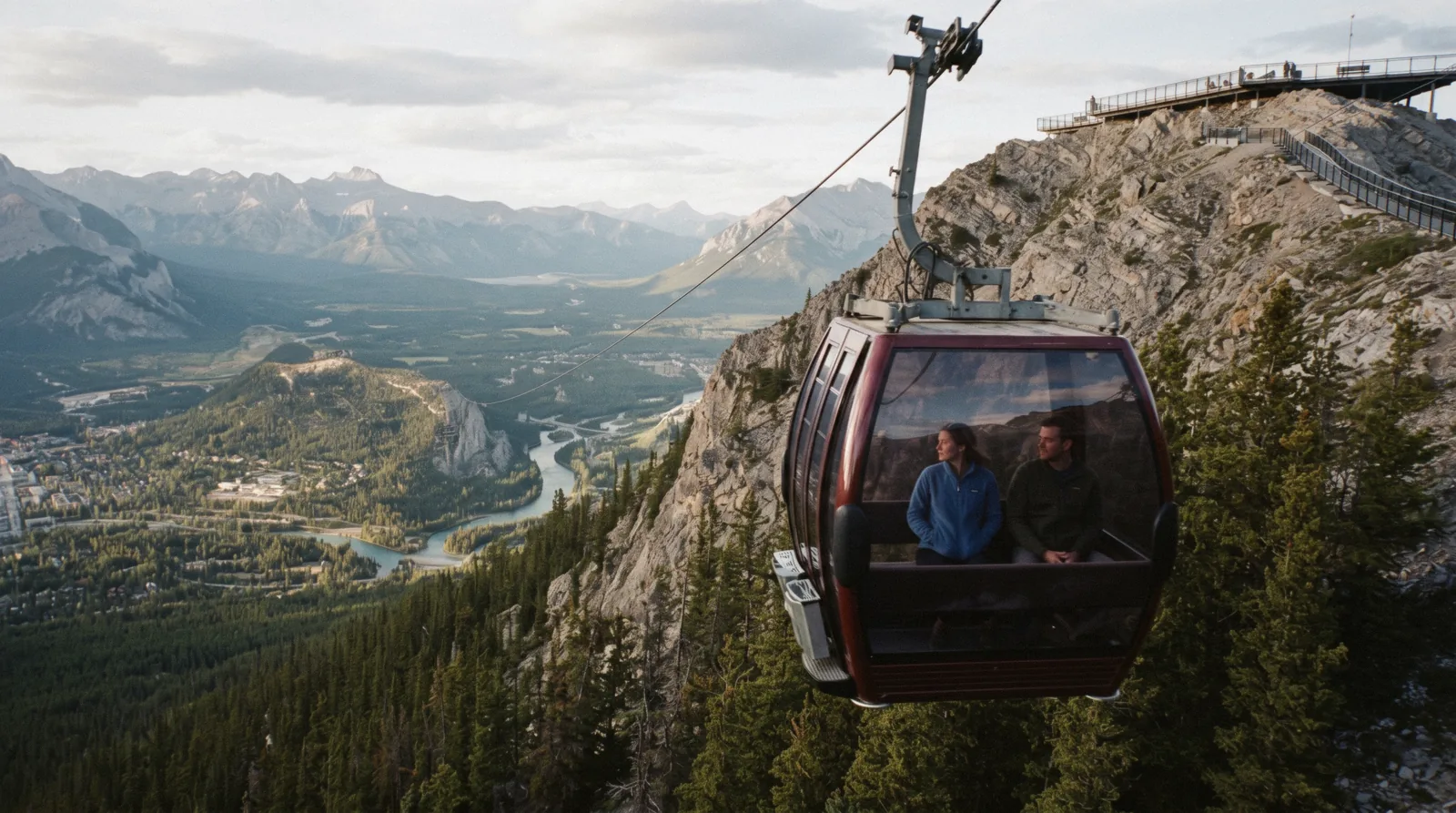
Banff at Night: Dark Skies, Patios, the Aurora Question
Banff at night splits into three different evenings. There is the dark-sky evening at the lakes, the warm-water evening up Sulphur Mountain, and the town evening of patios and lit-up heritage buildings. This page plans all three, with the figures pulled from official operator pages. The whole valley, start to finish: the Banff homepage.
Quick answer The short version of Banff after dark
Banff at night is best spent at Lake Minnewanka and Two Jack Lake, the two standard dark-sky stops about 20 minutes from town by the road, where the skies are dark enough for stars on clear evenings. Two Jack Lake and Lake Minnewanka are the standard dark-sky stops in the park. If you want company and a telescope, a guided option such as the Nightfall Stargazing Tour handles the driving and the gear. If you want warmth instead, the Upper Hot Springs pool stays open to 10 pm with last entry at 9:30 pm. The aurora is a possibility, never a promise, and this page explains why. Before you plan the rest of the trip, skim our pages on the park pass and what Banff costs so the evening fits the budget.
Key takeaways
- Two Jack Lake and Lake Minnewanka are the standard dark-sky stops. The cruise dock sits a 20-minute drive from town by the operator's own wording. If you would rather ride than drive, the Lake Minnewanka Cruise runs from May 8 to October 12 in 2026.
- For a guided sky, compare the Banff Nightfall Stargazing Tour with the two-hour Stargazing Walking Tour before you pick.
- The Upper Hot Springs charge $14.02 (C$19.75) per adult, open daily 10 am to 10 pm, last entry 9:30 pm, no reservations. Details on our Banff Upper Hot Springs page.
- Every visitor needs a park pass for anything outside town. Our Parks Canada pass page explains the options.
Night Tickets Compared
Four paid products fill a Banff evening: the mountain pool, the summit ride, the lake boat and the guided sky. This table compares what each one costs and when it runs at night. The hot springs figure comes from the Parks Canada fees page, converted at our fixed site rate. The gondola and the cruise publish no static prices, so their rows point at the official source and at a bookable tour listing whose price is the listing's own. Tour prices are in US dollars as listed on the platform.
Do you want water, a summit, a boat or a telescope?
| Night option | Price | Evening hours | Booking | Book |
|---|---|---|---|---|
| Banff Upper Hot SpringsAnyone who wants a warm, cheap and reliable evening that works in any weather | $14.02 (C$19.75) adult, locker token included | Daily 10 am to 10 pm, last entry 9:30 pm | In person only, no reservations | Official site |
| Banff Gondola Ride AdmissionTravellers who want the summit boardwalk in evening light rather than midday crowds | $68.04 as listed | Hours vary by season, last ride up 7:30 pm in the fall window per the operator's posted hours | Timed tickets, advance booking recommended | Check Availability |
| Lake Minnewanka CruiseDaytime planners, since the boat does not run late enough to count as a night activity in fall | $58.09 as listed | Season May 8 to October 12, 2026, fall departures 10 am to 5 or 6 pm | Check in 15 minutes before departure | Check Availability |
| The Banff Stargazing Walking TourVisitors without a car who want a guided sky with the walking kept short | $66.97 as listed | 2 hours, evening departures per the listing | Book ahead, weather dependent | Check Availability |
Prices for the hot springs are the official Parks Canada fees. Tour figures are the platform listings' own prices. The gondola operator prints no fixed price on its site, so any gate figure you see elsewhere is an estimate. Figures current for in Q3 2026.
The Evening, Numbered
One workable Banff night, in order. Times are our own arithmetic from the published figures, and every stop is on the map further down the page.
-
Town pay parking is enforced 8 a.m. to 8 p.m. daily. After 8 p.m., on-street and lot parking in the pay zone is free. In winter the rate is $4.97 (C$7) per hour during the day, dropping to $2.84 (C$4) is not correct, the winter rate is $4.97 (C$7) per hour, summer $8.52 (C$12) per hour. Free all-day parking sits at the Train Station lot with about 500 stalls. See our getting around page for buses.
-
The destination marketing organization lists around 140 restaurants for Banff and Lake Louise. Kitchen hours are not stated on any single official page, so book ahead on our where to eat picks if a patio is the plan.
-
-
Two Jack Lake and Lake Minnewanka are the standard dark-sky stops. The drive from the townsite is our estimate of about 20 minutes, matching the operator's wording for the cruise dock. Full details in the night drives section below and on our Lake Minnewanka page.
-
The Banff Nightfall Stargazing Tour runs a dark-sky hour at Minnewanka and Two Jack with telescopes and hot chocolate, priced at checkout on the listing. The two-hour Stargazing Walking Tour stays on foot at $66.97 as listed.
-
Stargazing: the Dark-Sky Corridor and Where to Stand
Banff National Park sits in the mountain parks, far from big-city glow, and the park road corridor along the Bow Valley is where the sky opens up. You do not need a telescope. You need distance from streetlights, a clear horizon and warm clothes, because the town sits at 1,383 metres and the clear-season nights are cold.
Why the lakes are the standard answer
Two Jack Lake and Lake Minnewanka are the standard dark-sky stops, and they earn it for three reasons. First, they sit up the Lake Minnewanka road, away from the town's light dome. Second, the shorelines face open water, so the sky runs to the horizon in front of you.
Third, both have parking at the shore, so there is no night hike involved. On a clear moonless night the Milky Way shows to the eye. Our estimate for the drive from Banff Avenue is 15 to 20 minutes, which matches the cruise operator's own phrase of a 20-minute drive from the town of Banff.
The spots, in order of ease
The table compares the four evening standpoints most people use. Distances from downtown Banff are our estimates from the map pins. Fees come from the Parks Canada and town pages already cited.
| Spot | Distance from town | What you get | Cost |
|---|---|---|---|
| Two Jack Lake | our estimate 15 min drive | Open water horizon, roadside parking at the shore | Free with park pass |
| Lake Minnewanka day-use area | our estimate 20 min drive | Biggest sky, the cruise dock and parking lot | Free with park pass |
| Vermilion Lakes | our estimate 10 min drive | West-facing water, closer to town, some town glow | Free with park pass |
| Tunnel Mountain summit | hike, trailhead near town | Full 360 sky above the light dome, a real climb in the dark | Free with park pass |
What to bring
Temperatures matter more than optics. The climate record for the townsite puts the January average low at minus 13.9 C and the July average low at 9.4 C, so even a summer stargazing hour needs a real jacket. A red-filtered headlamp or phone light protects your own night vision and everyone else's.
Bear spray is the official year-round rule for any trail work in the park, carried where you can reach it, not buried in the pack. If wildlife is on the road on the drive out, the park rule is slow down, stay in your vehicle, take a photo and move on.
Going guided
If you have no car or no confidence in the dark, two bookable formats cover it. The Banff Nightfall Stargazing Tour is a vehicle-based dark-sky hour at Minnewanka and Two Jack with telescopes and hot chocolate, priced at checkout on the listing. The Banff Stargazing Walking Tour runs two hours on foot with a guide reading the constellations, at $66.97 as listed on its platform. Both are weather dependent, and cloud in the mountains can cancel the best-laid plan.
The town compromise
Not every night allows a drive. The Banff Avenue corridor and the riverfront parks keep the big peaks visible even under streetlights, and the Banff Park Museum and Whyte Museum buildings stay lit after dark for photographs. It is a lesser sky, but it is a five-minute walk from most hotels.
Sky conditions are a general guide. Hours, distances and prices come from Parks Canada, the Town of Banff and the operators cited on this page.
The Aurora Possibility, Honestly
Can you see the northern lights in Banff? Sometimes. Any page promising them is selling something. Here is what the facts actually support.
The honest answer
Banff sits far enough north for aurora to reach it during strong solar activity, and far enough south that it is a bonus rather than a fixture. No official Banff page publishes aurora statistics, frequency or a viewing season, and that absence is itself the finding. Treat every display as luck stacked on preparation, not as an itinerary item.
What improves your odds
Our own read of the conditions is a short list. Dark sky, so the lake stops above beat anywhere in town. Clear weather, which the mountain climate grants and withholds without pattern.
High solar activity, which you check on a space-weather forecast the same day. Darkness, which argues for the hours around the new moon. And patience, because displays that reach this latitude are often brief.
Where to stand if the forecast spikes
The same dark-sky stops double as aurora stops. Lake Minnewanka and Two Jack give you a low northern horizon across water, which is exactly what a display needs. Vermilion Lakes works too and sits closer to town, with some glow trade-off. The gondola summit is an aurora photo spot in the operator's marketing, but the last ride down falls well before true darkness in the fall hours, so our pick is the lake road.
Do not build the trip on it
Plan the evening around the reliable stuff, the hot pool, the patios, the stars that show every clear night, and let the aurora arrive unannounced. The travellers who report a display usually report it as a surprise on the drive back from the lakes, not as a booked appointment.
Aurora forecasting is a general science question, not an operator product. Background figures on this page come from Parks Canada and the Town of Banff.
Evening Patios and the Mountain-Town Night
Banff nightlife is quiet by city standards and busy by national-park standards. The town holds about 8,000 residents, a summer day brings around 43,000 visitors, and most of them leave the bars early because the alarm is set for a lake shuttle.
What the official record says
The destination marketing organization lists about 140 restaurants across Banff and Lake Louise, and the town caps commercial space at roughly 10 percent of the townsite by federal law, so the scene is dense but bounded. No official page prints a bar-by-bar hours list, and we will not invent one. What we can say is that the concentration runs along Banff Avenue and the cross streets of the downtown grid, all within a few minutes' walk of the hotels on our where to stay page.
The hotel bars
The Fairmont Banff Springs alone advertises 12 restaurants and bars, including the Rundle Bar, where the hotel serves its afternoon tea. The hotel prints no bar hours or cover policy on its public pages, so call ahead for anything specific. The building, open since 1888, is worth the visit for the lobby and the terrace view even if you only have one drink. Bow Falls sits below it, loud in the dark if you walk down from Surprise Corner, a short distance our estimate places at a few minutes on foot.
Evenings with a schedule
The town calendar puts real events after dark. New Year's Eve has a family-friendly town event. The Santa Claus Celebration of Lights fills Banff Avenue in mid-November each year.
SnowDays, the winter festival run by the tourism board, spreads across late January into early February, with the 2027 edition listed January 21 to February 7. None of these need a ticket from us, and dates change yearly, so check the town calendar before you travel.
Getting back after dark
Roam Transit local fares are $1.42 (C$2) per adult single ride or $3.55 (C$5) for a local day pass, with children 12 and under free. Buses thin out in the evening and headways are not printed on the route pages, so our advice is to check the schedule before dinner rather than after. Walking the downtown grid is safe and short, with wildlife-proof garbage bins and, most nights, elk somewhere on the edges of town.
Counts and town figures come from banff.ca and Banff Lake Louise Tourism. Individual bar hours are not stated on any official page we checked.
Night Drives: Minnewanka and Two Jack
The Lake Minnewanka loop is the single best drive Banff at night offers. It leaves town, climbs through forest and delivers two dark-sky lakes in under half an hour, our estimate, matching the operator's 20-minute figure for the cruise dock.
The route
Head north out of town toward the Lake Minnewanka road and take the loop past Lake Minnewanka and Two Jack Lake. The cruise operator's own directions describe the dock as a 20-minute drive from the town of Banff, and the loop connects back toward the townsite. Fuel up in town, because nothing on the loop stays open at night, and there is no cell service to rely on at the far end.
Two Jack first, Minnewanka after
Our pick is to stop at Two Jack on the way in, because its shoreline faces open water with a short walk from the lot, then finish at Lake Minnewanka where the parking lot gives the widest sky. The Minnewanka day-use area is described by Parks Canada as a great destination for cross-country skiing, winter walking or snowshoeing, which tells you it stays a maintained destination in the cold months. Note the 2026 safety closure: the Lake Minnewanka backcountry area and trails were closed from September 16 until further notice, which affects trails, not the roadside day-use stopping points.
Driving after dark: the wildlife rules
Night driving here is wildlife driving. The park's rule for roadside animals is to slow down, stay in your vehicle, take a photo and move on. Keep at least 30 metres, about three bus lengths, from elk and deer, and at least 100 metres from wolves and cougars per the town and park guidance.
The elk rut runs from late August to mid-October and bulls can be aggressive, so give the roadside meadows extra room in fall. Report bears, cougars, wolves or coyotes to Banff Dispatch at 403-762-1470. Fines for wildlife offences reach up to $17.74 (C$25),000.
Parking the plan
The loop's lots are free with your park pass, unlike the downtown meters. The day pass costs $8.69 (C$12.25) per adult, $7.63 (C$10.75) senior, with youth 17 and under free, and stays valid until 4 pm the day after purchase, so an evening on the loop usually rides a pass you already hold. Our own comparison of pass options lives on the park pass page.
In winter, carry winter tires or comfort with mountain roads, because the highway is maintained but the cold is real, with January lows averaging minus 13.9 C.
Road facts and wildlife rules come from Parks Canada and the Town of Banff.
Map of the Night
Every stop mentioned on this page, from the town pin to the lake road and the hot springs. Distances between pins are our estimates from the coordinates.
Night and Evening Tours
The bookable options that run after sundown or fill the shoulder hours. Tour prices are the listings' own, in US dollars.
from Listed at checkout
Banff Nightfall Stargazing Tour
A guided dark-sky hour at Minnewanka and Two Jack, telescopes and hot chocolate included.
Check Availability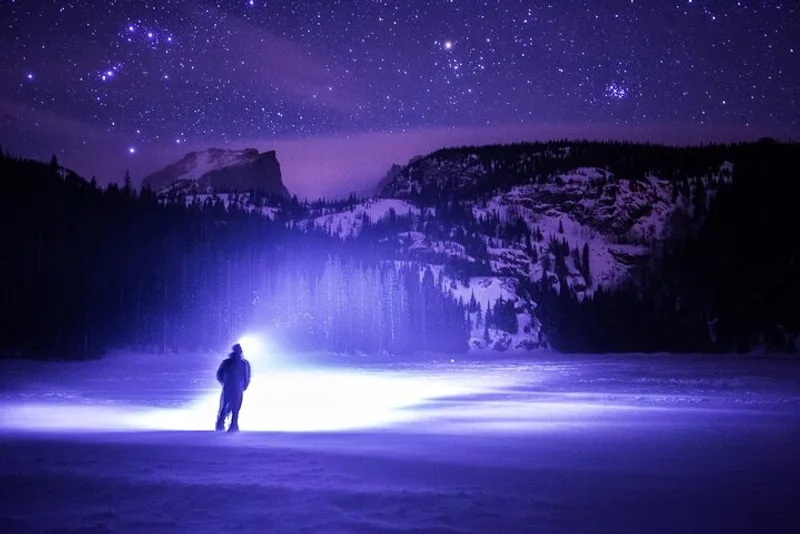 from $66.97
The Banff Stargazing Walking Tour
A two-hour walking tour under the dark-sky corridor with a guide telling the constellations and the park's night rules.
Check Availability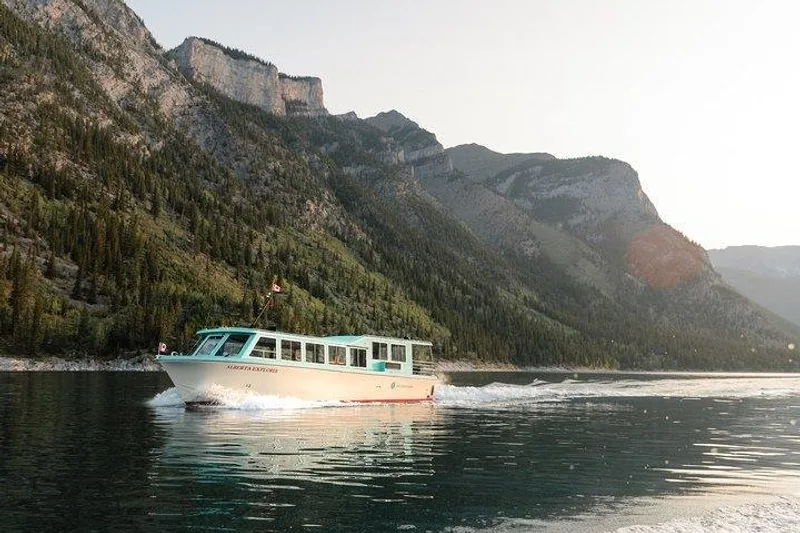 from $58.09
Lake Minnewanka Cruise
The only boat tour allowed on Banff's biggest lake, an hour out among the glacier-carved shores of Lake Minnewanka.
Check Availability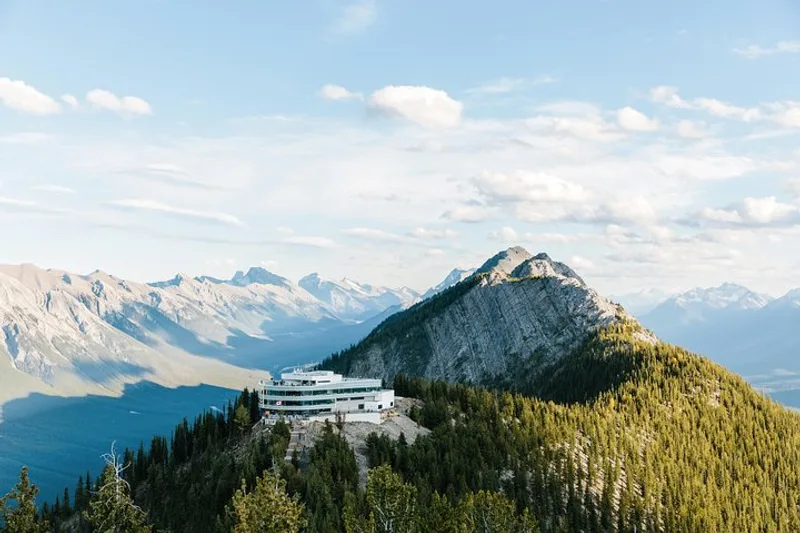 from $68.04
Banff Gondola Ride Admission
The ride up Sulphur Mountain to the ridge boardwalk, booked as a timed ticket; summit boardwalk and cosmic ray station included.
Check AvailabilityPrices, ratings and details are the platform's own. dollar figures are the listed prices — the platform bills in your account's currency.
Banff at Night: Questions
Can you see the northern lights in Banff?
Sometimes. Banff sits far enough north for aurora during strong solar activity and far enough south that displays are irregular. No official Banff page publishes aurora frequency or a season. Check a space-weather forecast the same day and head for the dark-sky lake stops if the numbers spike.
Where are the best stargazing spots in Banff?
Two Jack Lake and Lake Minnewanka are the standard dark-sky stops, both with shore parking up the Lake Minnewanka road. Vermilion Lakes works if you want to stay closer to town. Tunnel Mountain gives a full-sky summit for those willing to hike in the dark.
Is it safe to drive from Banff to Lake Minnewanka at night?
The road is maintained and the drive is about 20 minutes by the cruise operator's own wording. The real risk is wildlife on the road. Slow down, never stop beside elk during the late August to mid-October rut, and keep at least 30 metres from elk and deer, 100 metres from wolves and cougars.
What is open late in Banff?
The Upper Hot Springs pool opens daily 10 am to 10 pm with last entry at 9:30 pm, and it stays open on holidays including Christmas Day. The gondola runs evening hours that shift by season, with posted last rides up at 7:30 pm in the fall window and later in winter. Bars and restaurants do not publish hours on any single official page.
Do I need a park pass for stargazing?
Yes for anywhere outside the townsite. A day pass costs $8.69 (C$12.25) per adult and stays valid until 4 pm the day after purchase, so an evening drive on the Minnewanka loop usually rides a pass you already hold from that day.
Can you stargaze in Banff without a car?
Yes, by joining a guided option. The Banff Nightfall Stargazing Tour runs a vehicle-based dark-sky hour at Minnewanka and Two Jack, and the two-hour Stargazing Walking Tour covers the sky on foot. Roam Transit local fares are $1.42 (C$2) per ride, but evening headways are not printed on the route pages.
We may earn a commission if you book through one of our links, at no extra cost to you. Full affiliate disclosure